When you look up at the night sky, the stars appear to be scattered randomly. But thousands of years ago, ancient astronomers noticed that the Sun, Moon, and visible planets always seemed to travel along a specific, predictable path across the heavens.
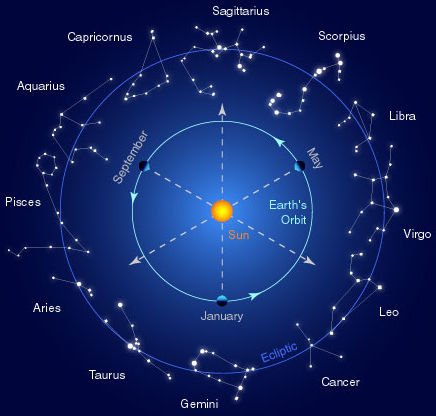
This pathway is called the ecliptic, and the band of stars that sits as the backdrop to this path is what we call the zodiac.
However, what astronomers mean by “the zodiac” and what astrologers mean by “the zodiac” are two very different things today. To understand your place in the stars, you have to untangle the physical science of astronomy from the mathematical tradition of astrology.
The Astronomy: The Physical Constellations
From a strictly scientific perspective, a constellation is simply a grouping of stars that appears to form a pattern from our vantage point on Earth. The zodiac constellations are special only because of their location: they lie directly along the ecliptic plane.
If you could see the stars during the daytime, you would see the Sun slowly drifting in front of these specific constellations throughout the year as the Earth completes its orbit.
The Sizes Are Not Equal
In astronomy, constellations are like countries on a map—they have wildly different borders and sizes.
Because they vary in size, the Sun does not spend exactly one month in each constellation. For instance, Virgo is a massive constellation. From our perspective, the Sun spends about 45 days moving through Virgo. In contrast, Scorpius has a very narrow section of the ecliptic crossing it, meaning the Sun zips through Scorpius in just 7 days.
The “13th” Constellation: Ophiuchus
If you track the exact astronomical path of the Sun today, it actually passes through 13 constellations, not 12.
Between Scorpius and Sagittarius, the ecliptic crosses the feet of a constellation known as Ophiuchus (the Serpent Bearer). The Sun actually spends nearly three times as long in Ophiuchus (about 18 days) as it does in Scorpius. Ancient Babylonian astronomers were aware of Ophiuchus, but they intentionally left it out to cleanly divide the 360-degree path into 12 tidy slices of 30 degrees each to match their 12-month calendar.
The Astrology: The Conceptual Framework
While astronomy deals with the physical, irregularly shaped groupings of stars, Western astrology uses the zodiac as a conceptual measuring tool.
Signs vs. Constellations
In astrology, a “sign” is not the same thing as a “constellation.”
Around 2,000 years ago, astrologers took the 360-degree ecliptic path and divided it into 12 perfectly equal slices of 30 degrees each. They named these mathematical slices after the constellations that generally aligned with them at the time.
So, when a Western astrologer says the Sun is in Aries, they don’t mean the Sun is physically blocking the stars of the Aries constellation. They mean the Sun is traveling through the first 30-degree slice of the sky, which begins on the exact moment of the Spring Equinox.
The Precession of the Equinoxes
Because the Earth wobbles slightly on its axis like a spinning top, our vantage point shifts over the millennia. This wobble pushes the physical constellations out of alignment with the seasons by about 1 degree every 72 years.
Two thousand years ago, the astrological sign of Aries and the physical constellation of Aries occupied the exact same space in the sky. Today, they are off by about 24 degrees (almost an entire sign). If you are born on April 1st, your astrological sign is Aries, but if an astronomer points a telescope at the Sun on your birthday, the Sun is actually sitting right in the middle of the physical constellation of Pisces.
Ultimately, astronomy uses the stars as a physical map of the universe, while astrology uses the conceptual zodiac as a calendar to measure the Earth’s seasonal relationship with the Sun.
To see exactly how this works in three-dimensional space, you can explore the model below. It demonstrates how Earth’s orbit dictates the Sun’s apparent position against the backdrop of the celestial sphere.