When you begin learning about astrology, the sheer amount of information can be overwhelming. Planets, houses, aspects, and modalities all weave together to form a complex system. However, the most foundational building block of Western astrology is incredibly intuitive: the four natural elements.
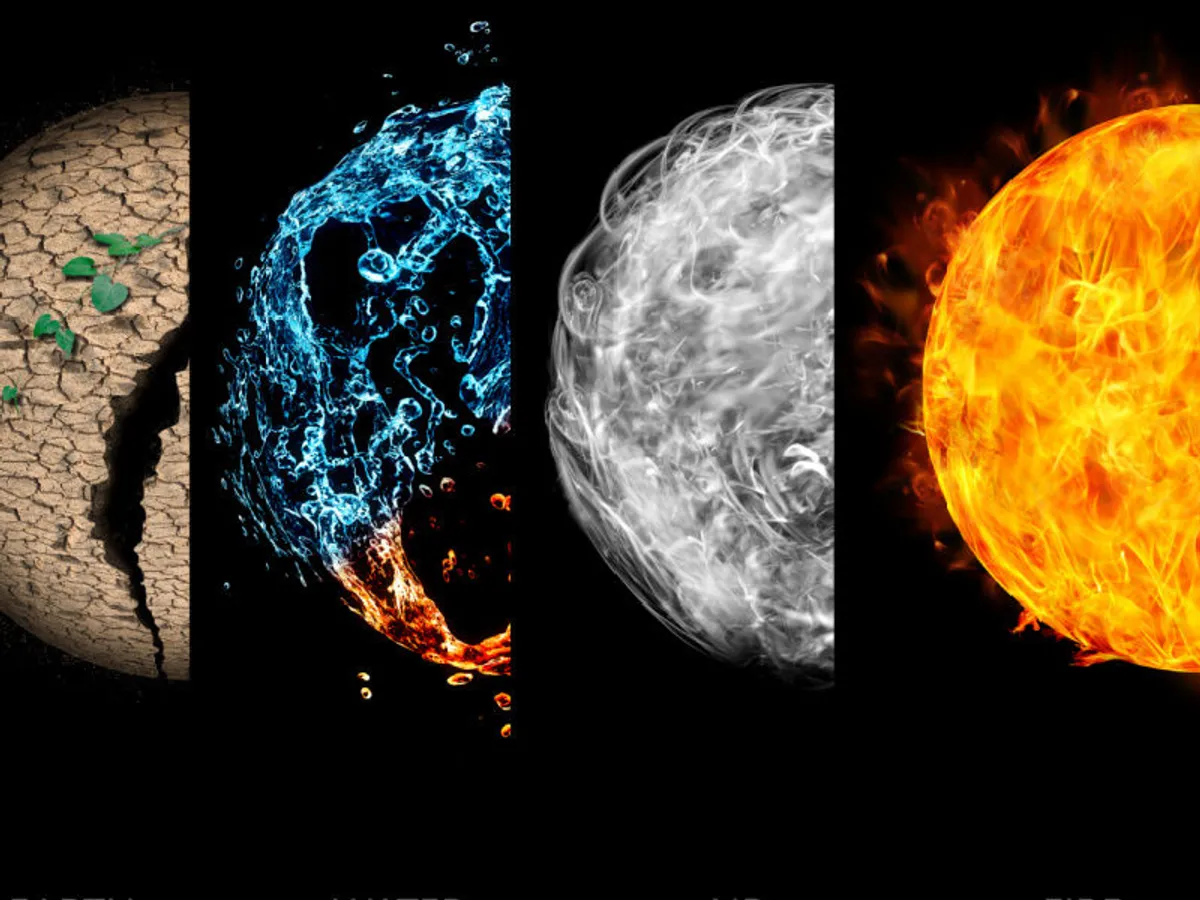
Every one of the 12 zodiac signs belongs to one of four elemental categories: Fire, Earth, Air, or Water.
In traditional astrology, these elements are not literal; they are symbolic archetypes. They describe the basic temperament, primary motivations, and energetic signature of a zodiac sign. Understanding a sign’s element is the fastest way to grasp its core nature. For instance, you do not need to memorize every trait of an Aries to know that as a Fire sign, it will be naturally energetic, impulsive, and warm.
This guide explores the historical origins of these four elements, breaks down the core characteristics of each, and explains how the element expresses itself uniquely through its three associated zodiac signs.
The Origins of the Four Elements in Astrology
The concept of the four elements predates modern astrology by centuries. It is rooted in ancient Greek philosophy, most notably credited to the pre-Socratic philosopher Empedocles in the 5th century BCE. He proposed that all matter in the universe was composed of four “roots”: fire, air, water, and earth.
Later, Plato and Aristotle expanded upon this, assigning specific qualities (hot, cold, wet, dry) to these elements. As Hellenistic astrology developed in Alexandria around the 2nd century BCE, early astrologers seamlessly integrated this established philosophical framework into the zodiac. The 12 signs were divided evenly among the four elements, creating the system we still use today.
While modern science has long since replaced the four elements with the periodic table to explain literal matter, astrology retains them as a highly effective psychological and symbolic language for describing human behavior.
Fire Signs: Aries, Leo, Sagittarius
Core Characteristics: Passionate, dynamic, impulsive, inspiring, and action-oriented.
Fire signs represent the spark of life. They are characterized by a high-energy, radiant quality that naturally draws attention. In astrological tradition, Fire is the element of inspiration, intuition (in the sense of gut instincts), and forward momentum. Those with heavy Fire placements in their birth charts are often seen as enthusiastic, courageous, and occasionally quick-tempered. They do not wait for things to happen; they make them happen.
How Fire Manifests in Each Sign
While all three share the same fiery nature, their specific “type” of fire differs:
-
Aries (March 21 – April 19): The Spark. Aries is the first sign of the zodiac, representing the initial, explosive burst of a match being struck. Its fire is pioneering, fast-burning, and focused on initiation and bold action.
-
Leo (July 23 – August 22): The Hearth Fire. Leo represents a sustained, controlled, and warming fire. Like a roaring bonfire that people gather around, Leo’s fire is focused on radiance, creativity, generosity, and sustaining a bright, visible presence.
-
Sagittarius (November 22 – December 21): The Wildfire. Sagittarius is an expansive, fast-moving fire that spreads across the landscape. Its energy is restless and philosophical, constantly seeking new terrain, truth, and experiences to consume and illuminate.
Earth Signs: Taurus, Virgo, Capricorn
Core Characteristics: Practical, grounded, sensual, reliable, and materially focused.
Earth signs are the builders of the zodiac. Where Fire provides the initial inspiration, Earth provides the practical framework to make that inspiration a physical reality. In astrology, the Earth element rules the material world: finances, physical health, careers, and the tangible results of our labor. Earth signs are known for their pragmatism, patience, and dependability. They rely on their physical senses and prefer reality over theory.
How Earth Manifests in Each Sign
-
Taurus (April 20 – May 20): The Fertile Soil. Taurus represents the rich, receptive earth of spring. It is focused on physical security, sensory pleasure, and slow, steady accumulation. Its earth is about holding ground and nurturing growth.
-
Virgo (August 23 – September 22): The Harvest. Virgo represents the earth that has been worked, cultivated, and harvested. Its energy is highly analytical and service-oriented, focusing on refining, organizing, and perfecting the material world for practical use.
-
Capricorn (December 22 – January 19): The Mountain. Capricorn represents the sheer, solid rock of a mountain peak. Its earth is structural, ambitious, and authoritative. It focuses on long-term achievement, discipline, and building lasting legacies.
Air Signs: Gemini, Libra, Aquarius
Core Characteristics: Intellectual, communicative, social, analytical, and abstract.
Air signs are the thinkers and communicators of the zodiac. Air is the only element that cannot be contained or easily seen, reflecting its association with the mind, ideas, and abstract concepts. Astrologically, Air governs social networks, language, logic, and interpersonal relationships. Those with strong Air placements tend to process the world intellectually rather than emotionally or physically. They are the objective observers and the synthesizers of information.
How Air Manifests in Each Sign
-
Gemini (May 21 – June 20): The Breeze. Gemini represents the swift, changing breezes that scatter pollen. Its air is curious, adaptable, and restless, focused on gathering and exchanging small pieces of information and immediate social interactions.
-
Libra (September 23 – October 22): The Winds of Change. Libra represents the stabilizing wind that seeks equilibrium. Its air is focused entirely on one-on-one relationships, diplomacy, aesthetic harmony, and weighing different intellectual perspectives to find balance.
-
Aquarius (January 20 – February 18): The Jet Stream. Aquarius represents the high-altitude, global air currents. Its air is visionary, fixed, and highly conceptual. It focuses on large-scale social systems, innovation, collective ideals, and objective truth.
Water Signs: Cancer, Scorpio, Pisces
Core Characteristics: Emotional, intuitive, empathetic, secretive, and deeply connected.
Water signs are the emotional compasses of the zodiac. Just as water is fluid, taking the shape of whatever container it is poured into, Water signs are highly adaptable and profoundly sensitive to their environments. In astrology, Water governs memory, the subconscious, intuition, and deep emotional bonds. Water signs process the world through feeling and empathy, often possessing a “sixth sense” about the unspoken dynamics in a room.
How Water Manifests in Each Sign
-
Cancer (June 21 – July 22): The River. Cancer represents the nourishing, localized waters of a stream or a safe harbor. Its water is protective, deeply tied to family and ancestral roots, and focused on creating emotional security and providing care.
-
Scorpio (October 23 – November 21): The Deep Ocean. Scorpio represents the immense, pressurized depths of the ocean. Its water is intense, mysterious, and transformative. It focuses on psychological depth, intimacy, uncovering hidden truths, and emotional resilience.
-
Pisces (February 19 – March 20): The Mist. Pisces represents water in its most ethereal state: fog, rain, or a boundless sea. Its water is universally empathetic, spiritual, and boundaryless. It focuses on artistic imagination, compassion, and the interconnectedness of all things.
Common Misconceptions About Astrological Elements
One of the most frequent misunderstandings in modern astrology occurs when people assume they lack a certain human trait because they lack that element in their “sun sign.” For example, someone with an Earth sun sign might incorrectly assume they are not creative (Fire/Water), or someone with no Water in their “big three” (Sun, Moon, Rising) might worry they lack empathy.
This is a misinterpretation of how astrology works.
First, your sun sign is just one piece of your full natal chart. You have all 12 signs (and therefore, all four elements) somewhere in your birth chart, governing different areas of your life (represented by astrological “Houses”). Second, missing an element in your major planetary placements does not mean you lack those traits entirely; it simply means you may have to work more consciously to integrate that energy into your life, rather than it being your default, effortless setting.
Conclusion: Finding Balance in the Elements
The four elements are a reminder that the zodiac is fundamentally a system of balance. No single element is inherently better or more advantageous than another.
Fire needs Earth to ground its ideas into reality. Earth needs Water to nourish its soil and keep it from becoming barren. Water needs Air to gain objective perspective on its overwhelming emotions. And Air needs Fire to give its abstract ideas passion and momentum. By understanding the elements of the zodiac, you gain a practical, foundational tool for understanding how different personalities process the world, communicate their needs, and ultimately complement one another.