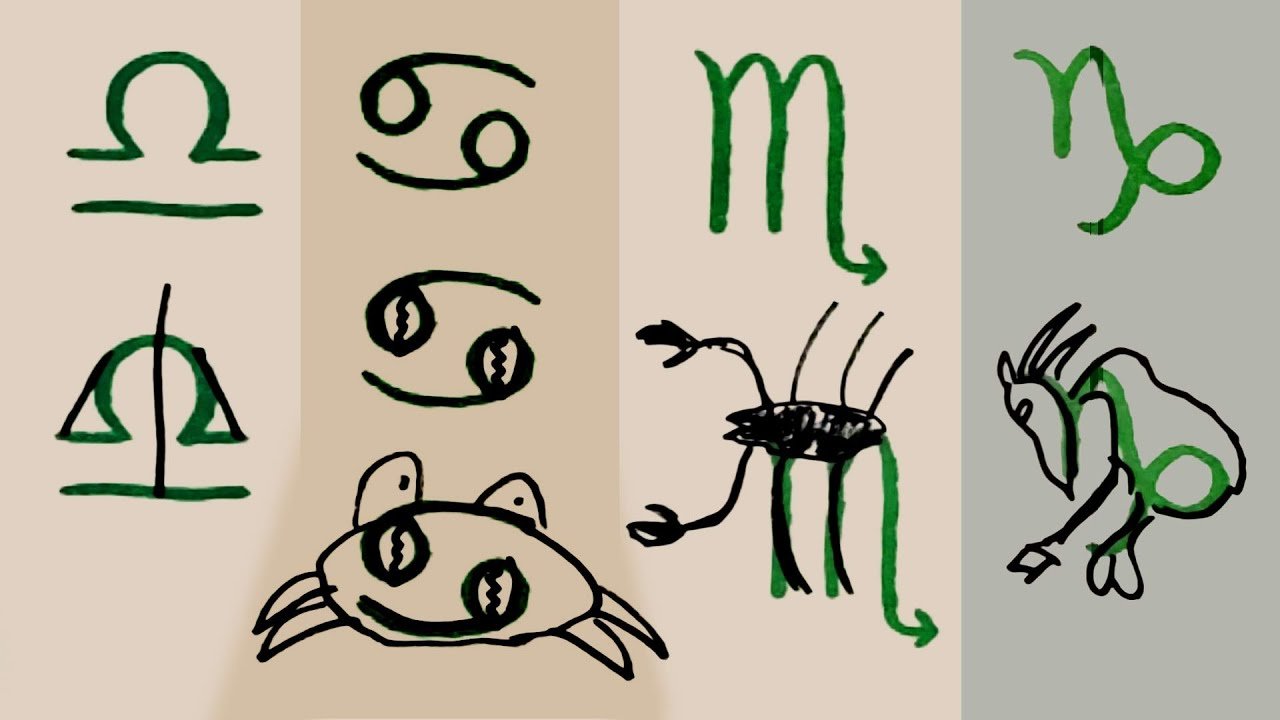
When you look at a horoscope or an astrological chart, you are reading a visual language that is thousands of years old. Every zodiac sign is represented by two distinct visual markers: a representative avatar (usually an animal or mythological figure) and a stylized symbol called a “glyph.”
These symbols were not chosen randomly. They are deeply rooted in ancient Mesopotamian astronomy and Greek mythology. The ancients looked up at the star constellations, connected the dots to form shapes, and assigned stories to these shapes to help navigate the seasons, track time, and understand human nature.
In this guide, we will explore the historical origins and the symbolic meanings behind the avatars and glyphs of all 12 zodiac signs.
1. Aries: The Ram (♈)
-
The Glyph: The Aries symbol looks like the curving horns of a ram. It can also represent the human eyebrows and nose, tying into Aries’s traditional astrological rulership of the head.
-
The Origin: The symbol of the Ram traces back to the ancient Babylonian agricultural calendar, marking the time of year when sheep were sheared. In Greek mythology, Aries is associated with the story of the Golden Fleece. A magical flying ram with golden wool was sent by the gods to rescue the prince Phrixus. Later, this same Golden Fleece became the prize sought by the hero Jason and his Argonauts.
-
The Meaning: The Ram symbolizes leadership, courage, and head-first initiation. Just as a ram charges its obstacles, Aries energy is pioneering and fearless.
2. Taurus: The Bull (♉)
-
The Glyph: The Taurus symbol is a circle with two horns resting on top, representing the head of a bull.
-
The Origin: The Bull is one of the oldest recorded constellations, known as the “Bull of Heaven” in the ancient Mesopotamian Epic of Gilgamesh. In Greek mythology, Taurus is often linked to the Cretan Bull, a magnificent creature sent by Poseidon, or to the myth of Zeus transforming himself into a white bull to carry the Phoenician princess Europa across the sea.
-
The Meaning: The Bull represents raw, grounded power, physical endurance, and a connection to the earth. It embodies the slow, methodical strength required to cultivate the land and build lasting security.
3. Gemini: The Twins (♊)
-
The Glyph: The Gemini symbol looks like the Roman numeral II, representing duality, partnership, and the joining of two pillars.
-
The Origin: The symbol of the Twins comes directly from the Greek myth of Castor and Pollux (the Dioscuri). They were twin brothers born from the same mother but different fathers, making Castor mortal and Pollux an immortal demigod. When Castor died in battle, a heartbroken Pollux begged Zeus to share his immortality with his brother. Zeus agreed, transforming them into the constellation Gemini so they could remain together for eternity.
-
The Meaning: The Twins represent the dual nature of the human mind, constant communication, curiosity, and the eternal exchange of ideas.
4. Cancer: The Crab (♋)
-
The Glyph: The Cancer symbol looks like the number 69 resting on its side. These circular shapes represent the claws of a crab, or alternatively, the breasts, highlighting Cancer’s traditional association with motherhood and nurturing.
-
The Origin: In Greek mythology, the Crab makes a brief but memorable appearance during the second labor of Hercules. While Hercules was fighting the multi-headed Hydra, the goddess Hera (who hated Hercules) sent a giant crab to pinch his toes and distract him. Hercules quickly crushed the crab beneath his foot. Hera, appreciating the crab’s sacrifice, placed its image in the night sky.
-
The Meaning: The Crab symbolizes the hard exterior shell required to protect a soft, vulnerable, and deeply emotional interior. It represents defense, home, and protective instincts.
5. Leo: The Lion (♌)
-
The Glyph: The Leo symbol is a closed circle with a sweeping, curved tail, meant to depict the mane and tail of a lion.
-
The Origin: The Lion is universally associated with the blazing heat of the mid-summer sun. In Greek mythology, Leo is tied to the first labor of Hercules: the defeat of the Nemean Lion. This monstrous lion had golden fur that was impervious to mortal weapons. Hercules defeated the beast with his bare hands and later wore its indestructible pelt as armor.
-
The Meaning: The Lion represents royalty, pride, bravery, and theatrical self-expression. It is a symbol of the heart and the desire to shine brightly in the world.
6. Virgo: The Maiden (♍)
-
The Glyph: The Virgo symbol looks like an “M” with a closed loop crossing over the tail. This loop is traditionally said to represent closed legs, symbolizing chastity, purity, and boundaries.
-
The Origin: Virgo is the only zodiac sign represented by a female figure. In ancient times, this constellation was associated with various fertility and agricultural goddesses, including the Babylonian goddess Ishtar and the Greek goddess Demeter (goddess of the harvest). It is also heavily linked to Astraea, the virgin goddess of justice and purity, who abandoned Earth for the heavens when humanity became too corrupt.
-
The Meaning: The Maiden (often depicted holding a sheaf of wheat) symbolizes the harvest, hard work, physical health, purity of intention, and devoted service.
7. Libra: The Scales (♎)
-
The Glyph: The Libra symbol shows a straight horizontal line beneath a line that curves upward in a half-moon shape. This represents the setting sun over the horizon, as well as a pair of balancing scales.
-
The Origin: Libra is unique because it is the only zodiac sign represented by an inanimate object rather than an animal or human. The scales belong to Astraea (the Maiden of Virgo) or Themis, the embodiment of divine law and custom. In ancient Babylonian astronomy, this constellation was also known as the “Balance of Heaven.”
-
The Meaning: The Scales represent the eternal search for equilibrium, justice, fairness, and harmony in human relationships.
8. Scorpio: The Scorpion (♏)
-
The Glyph: Similar to Virgo, the Scorpio symbol is an “M,” but instead of a closed loop, the tail extends outward into an upward-pointing arrow, representing the venomous stinger of a scorpion.
-
The Origin: The myth of the Scorpion is deeply intertwined with the mighty hunter Orion. According to Greek myth, Orion boasted that he would kill every wild animal on Earth. Gaia, the goddess of the Earth, was enraged and sent a giant scorpion to stop him. The scorpion successfully stung and killed Orion. As a result, both were placed in the sky as constellations, but positioned on opposite sides of the heavens so the scorpion could eternally chase the hunter.
-
The Meaning: The Scorpion represents transformation, hidden danger, survival, and immense psychological depth.
9. Sagittarius: The Archer (♐)
-
The Glyph: The Sagittarius symbol is a simple, upward-pointing arrow with a crossbar on the stem, depicting the drawn bow of the Archer.
-
The Origin: Sagittarius is represented by the Centaur, a mythical creature with the upper body of a human and the lower body of a horse. Specifically, it is associated with Chiron, the wisest, most philosophical, and most civilized of all the centaurs. Chiron was a revered teacher, healer, and prophet who mentored many of Greece’s greatest heroes, including Achilles.
-
The Meaning: The Archer shooting his arrow into the sky represents the endless quest for higher truth, philosophical expansion, and physical exploration. The dual nature of the centaur also symbolizes the bridge between our wild, animalistic instincts and our higher human intellect.
10. Capricorn: The Sea-Goat (♑)
-
The Glyph: The Capricorn symbol is a complex, twisting glyph that looks like a “V” merging with a looping tail. It represents the horned head of a goat and the curling tail of a fish.
-
The Origin: The Sea-Goat is one of the oldest symbols in the zodiac, dating back to the Sumerian god Enki (or the Babylonian god Ea), the god of water, knowledge, and creation, who was depicted as a half-goat, half-fish. In Greek mythology, it is associated with the goat-god Pan, who dove into a river to escape the monster Typhon and attempted to transform into a fish, resulting in a hybrid creature.
-
The Meaning: The Sea-Goat represents mastering two different worlds: the deep, emotional waters of the soul (the fish tail) and the harsh, ambitious climb up the rocky material mountain (the goat).
11. Aquarius: The Water Bearer (♒)
-
The Glyph: The Aquarius symbol features two identical, jagged horizontal lines. While they look like ocean waves, they actually represent electrical currents or the ripples of wind on the water, highlighting that Aquarius is an Air sign, not a Water sign.
-
The Origin: Aquarius is represented by a human figure pouring water from a large amphora. In ancient Babylon, this was associated with the god Ea bringing the seasonal floods. In Greek mythology, the figure is Ganymede, a beautiful mortal prince who was abducted by Zeus to serve as the eternal cupbearer to the gods on Mount Olympus, pouring out the nectar of knowledge and life.
-
The Meaning: The water being poured represents life-giving knowledge, truth, and innovation being freely distributed to humanity. It symbolizes social consciousness and visionary thinking.
12. Pisces: The Fishes (♓)
-
The Glyph: The Pisces symbol shows two crescent moons facing outward, joined by a horizontal line in the middle. It represents two fish swimming in opposite directions, bound together by a celestial cord.
-
The Origin: The symbol of the two fish originates from a Greek myth involving the goddess of love, Aphrodite, and her son Eros. When the terrifying monster Typhon attacked Mount Olympus, the gods fled in terror. Aphrodite and Eros transformed themselves into two fish and dove into the Euphrates River to escape. To ensure they would not be separated in the dark waters, they tied their tails together with a strong cord.
-
The Meaning: The two fish swimming in opposite directions represent the eternal duality of the Pisces spirit: the struggle between existing in the harsh physical world and yearning for the boundlessness of the spiritual realm.
Conclusion
The 12 zodiac symbols are much more than modern graphic design. They are ancient artifacts of human storytelling. From the fearless Ram of the Babylonians to the wise Centaur of the Greeks, these symbols prove that human beings have always looked to the stars to understand their own nature. Learning the mythology behind your sun sign’s symbol offers a richer, more profound understanding of the archetypal energy that astrology seeks to describe.
External References
-
Encyclopedia Britannica – Zodiac: For historical verification of the Mesopotamian and Greek origins of the zodiacal constellations. (https://www.britannica.com/topic/zodiac)
-
NASA Space Place – What Are Constellations?: A useful educational resource explaining the difference between the physical star groupings and the mythological shapes humans assigned to them. (https://spaceplace.nasa.gov/constellations/en/)