If you have ever read a horoscope, you likely know your “sun sign”—the zodiac sign the sun was traveling through at the time of your birth. But the Western astrological zodiac is much more than a list of personality traits. It is a highly structured, symbolic system based on the changing of the seasons, ancient geometry, and thousands of years of historical tradition.
To truly understand how astrology categorizes human experience, you have to look under the hood. The 12 signs are not random; they are the result of combining four foundational elements with three energetic modalities.
In this guide, we will break down the mechanics of the zodiac, explain the difference between the astronomical constellations and the astrological signs, and detail the dates, symbols, and traditional meanings associated with all 12 signs.
The Building Blocks: Elements and Modalities
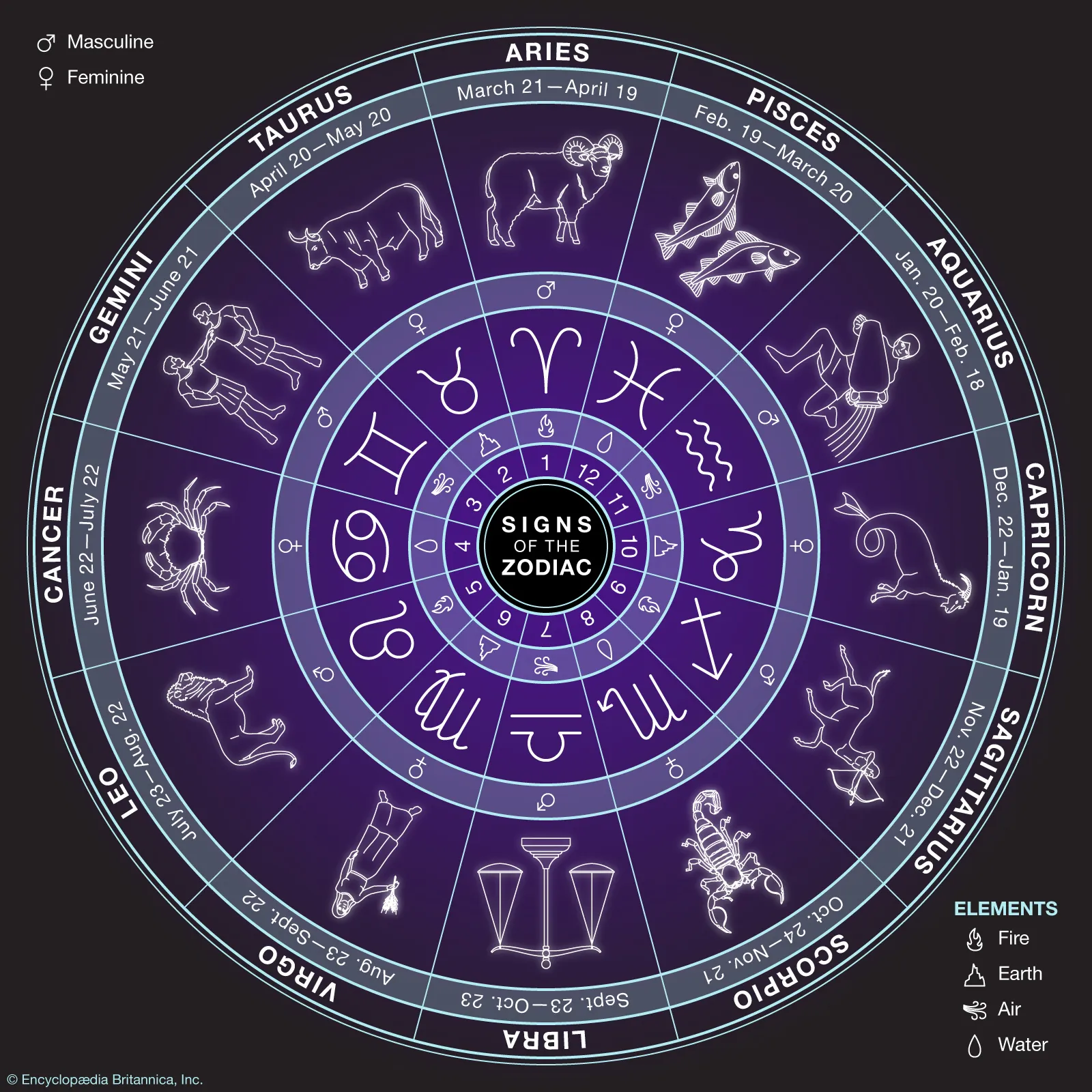
Before diving into the individual signs, it helps to understand how the zodiac wheel is constructed. Traditional Western astrology uses a mathematically symmetrical system. There are four elements and three modalities. When you multiply them (4 x 3), you get 12 unique combinations. No two signs share both the same element and the same modality.
The Four Elements
In astrological tradition, the elements describe a sign’s core nature and temperament.
-
Fire (Aries, Leo, Sagittarius): Associated with action, passion, energy, and impulse.
-
Earth (Taurus, Virgo, Capricorn): Associated with practicality, the physical world, stability, and pragmatism.
-
Air (Gemini, Libra, Aquarius): Associated with intellect, communication, social connection, and ideas.
-
Water (Cancer, Scorpio, Pisces): Associated with emotion, intuition, memory, and empathy.
The Three Modalities
While elements describe what a sign is made of, modalities describe how a sign operates and moves through the world. The modalities align with the beginning, middle, and end of the seasons in the Northern Hemisphere.
-
Cardinal (Aries, Cancer, Libra, Capricorn): The initiators. These signs mark the beginning of the four seasons (Spring, Summer, Autumn, Winter). They are associated with leadership, starting new projects, and forward momentum.
-
Fixed (Taurus, Leo, Scorpio, Aquarius): The sustainers. These signs fall in the middle of the seasons. They are associated with stability, endurance, concentration, and sometimes stubbornness.
-
Mutable (Gemini, Virgo, Sagittarius, Pisces): The adapters. These signs occur at the end of the seasons, as the weather is changing. They are associated with flexibility, transition, versatility, and open-mindedness.
The 12 Zodiac Signs: A Complete Guide
Below is a breakdown of the 12 signs of the Tropical zodiac, ordered as they appear on the astrological wheel, beginning with the Spring Equinox.
Note: The dates provided below are standard for Western astrology, but they can shift by a day depending on the specific year and time zone of your birth. If you were born on a “cusp” (the first or last day of a sign), you must calculate your exact birth chart to know your true sun sign.
1. Aries
-
Dates: March 21 – April 19
-
Symbol: The Ram (♈)
-
Element: Fire
-
Modality: Cardinal
-
Ruling Planet: Mars
Aries marks the beginning of the astrological year, coinciding with the Spring Equinox. As a Cardinal Fire sign, Aries is traditionally defined by bold initiation, courage, and a pioneering spirit. Like the Ram that represents it, Aries energy is headstrong and direct, often jumping into situations with enthusiasm and a desire to lead.
2. Taurus
-
Dates: April 20 – May 20
-
Symbol: The Bull (♉)
-
Element: Earth
-
Modality: Fixed
-
Ruling Planet: Venus
Taurus is a Fixed Earth sign, anchoring the middle of spring. Astrologers associate Taurus with physical comfort, patience, and a deep appreciation for the natural world. Represented by the Bull, this sign is known for its steady, methodical approach to life, prioritizing security, sensory pleasure, and long-term endurance over rapid change.
3. Gemini
-
Dates: May 21 – June 20
-
Symbol: The Twins (♊)
-
Element: Air
-
Modality: Mutable
-
Ruling Planet: Mercury
As spring transitions into summer, we encounter Gemini, a Mutable Air sign. Gemini is defined by duality, curiosity, and rapid information processing. Represented by the celestial Twins, Gemini energy is highly social, adaptable, and communicative, often seeking variety and intellectual stimulation in equal measure.
4. Cancer
-
Dates: June 21 – July 22
-
Symbol: The Crab (♋)
-
Element: Water
-
Modality: Cardinal
-
Ruling Planet: The Moon
Cancer begins with the Summer Solstice. As a Cardinal Water sign, it initiates through emotional connection and caretaking. The Crab symbolizes Cancer’s dual nature: a hard outer shell protecting a soft, vulnerable interior. In traditional astrology, this sign is deeply tied to home, family, ancestral memory, and emotional security.
5. Leo
-
Dates: July 23 – August 22
-
Symbol: The Lion (♌)
-
Element: Fire
-
Modality: Fixed
-
Ruling Planet: The Sun
Leo occupies the height of summer. It is a Fixed Fire sign, characterized by warmth, self-expression, and theatricality. Ruled by the Sun, Leo energy is historically associated with royalty, creativity, and the desire to be seen and appreciated. Like the Lion, Leos are traditionally viewed as fiercely loyal, proud, and protective.
6. Virgo
-
Dates: August 23 – September 22
-
Symbol: The Maiden (♍)
-
Element: Earth
-
Modality: Mutable
-
Ruling Planet: Mercury
Virgo ushers in the end of summer and the harvest season. As a Mutable Earth sign, Virgo combines the practicality of the material world with the flexibility needed to refine and improve it. Represented by the Maiden carrying a sheaf of wheat, Virgo is associated with analysis, service, organization, and a meticulous attention to detail.
7. Libra
-
Dates: September 23 – October 22
-
Symbol: The Scales (♎)
-
Element: Air
-
Modality: Cardinal
-
Ruling Planet: Venus
Beginning at the Autumn Equinox, Libra is a Cardinal Air sign focused on relationship dynamics. It is the only sign represented by an inanimate object—the Scales—highlighting its core drive for balance, justice, and harmony. Libra initiates action through collaboration, diplomacy, and a strong aesthetic appreciation.
8. Scorpio
-
Dates: October 23 – November 21
-
Symbol: The Scorpion (♏)
-
Element: Water
-
Modality: Fixed
-
Ruling Planet: Pluto (Modern) / Mars (Traditional)
Falling in the middle of autumn, Scorpio is a Fixed Water sign. While Water signs are emotional, Scorpio’s fixed nature gives it an intense, laser-like focus. Represented by the Scorpion (and sometimes the Eagle or Phoenix), this sign is associated with transformation, secrecy, psychological depth, and the navigation of life’s complex undercurrents.
9. Sagittarius
-
Dates: November 22 – December 21
-
Symbol: The Archer / Centaur (♐)
-
Element: Fire
-
Modality: Mutable
-
Ruling Planet: Jupiter
Sagittarius is a Mutable Fire sign that transitions the calendar into winter. Represented by the Centaur drawing a bow, Sagittarius energy is inherently expansive, seeking truth, meaning, and broad horizons. Astrologers link this sign to philosophy, higher education, travel, and a restless optimism.
10. Capricorn
-
Dates: December 22 – January 19
-
Symbol: The Sea-Goat (♑)
-
Element: Earth
-
Modality: Cardinal
-
Ruling Planet: Saturn
Kicking off the Winter Solstice, Capricorn is a Cardinal Earth sign. It is symbolized by the mythical Sea-Goat—a creature capable of climbing the highest mountains and navigating the deepest waters. Capricorn is traditionally associated with ambition, structure, discipline, and the slow, steady mastery of the material world.
11. Aquarius
-
Dates: January 20 – February 18
-
Symbol: The Water Bearer (♒)
-
Element: Air
-
Modality: Fixed
-
Ruling Planet: Uranus (Modern) / Saturn (Traditional)
Despite its symbol (the Water Bearer) and its name, Aquarius is a Fixed Air sign, not a Water sign. The water being poured represents knowledge and truth being shared with humanity. Aquarius is associated with social structures, innovation, rebellion, and collective ideals. It is often described as the most forward-thinking and eccentric of the zodiac signs.
12. Pisces
-
Dates: February 19 – March 20
-
Symbol: The Fishes (♓)
-
Element: Water
-
Modality: Mutable
-
Ruling Planet: Neptune (Modern) / Jupiter (Traditional)
Pisces completes the astrological wheel as winter shifts into spring. A Mutable Water sign, it is represented by two fish swimming in opposite directions, bound by a cord. This symbolizes the duality of Pisces—caught between the material world and the spiritual realm. Pisces is historically associated with deep intuition, artistic imagination, boundaries (or the lack thereof), and universal empathy.
The Science and the Symbolism: Tropical vs. Astronomical Zodiacs
When learning about the zodiac, a common misconception is that the astrological signs currently align with the star constellations in the sky. If you look at the constellation Aries today, it does not perfectly match the dates of the astrological sign of Aries.
Why does this happen? The Western astrological system uses the Tropical Zodiac. This system is not based on the physical stars, but rather on our perspective from Earth and our relationship with the Sun and the seasons. It locks the beginning of Aries to the exact moment of the Spring Equinox.
Due to a slow astronomical phenomenon known as the precession of the equinoxes (a slight wobble in Earth’s axis), the physical constellations have slowly drifted out of alignment with the seasons over the last 2,000 years. Therefore, Western astrology is a symbolic mapping of time, seasons, and earthly archetypes, rather than an observational science mapping literal groups of stars.
Conclusion: Putting It All Together
The 12 zodiac signs are more than isolated descriptions; they represent a complete cycle of human experience. From the initiating spark of Aries to the transcendent empathy of Pisces, the zodiac serves as a language for understanding different motivations, communication styles, and natural rhythms.
By understanding the underlying mechanics—how Fire, Earth, Air, and Water interact with Cardinal, Fixed, and Mutable energy—you can move beyond basic horoscopes and begin to understand the deep, structural logic that has kept astrology culturally relevant for millennia.