Have you ever plugged your birth details into an astrology calculator, expecting to read about your familiar Leo Sun, only to discover that according to another system, you are actually a Cancer? This identity-shaking moment is how most people discover the divide between Western astrology and Vedic astrology.
For decades, casual astrology readers have relied on their Sun signs to understand their personalities, relationships, and career paths. But as global spiritual practices become more accessible, the ancient Indian system of Vedic astrology—also known as Jyotish—has surged in popularity. Suddenly, people are faced with two completely different birth charts, different zodiac signs, and different predictive methods.
This creates a real problem for seekers looking for guidance: Which system is accurate? Why are the signs different? And most importantly, how can you use these systems to actually understand your life?
To solve this confusion, we need to strip away the mystery and look at the mechanical, philosophical, and astronomical engines that power both of these ancient traditions. Here is a comprehensive breakdown of the key differences between Western and Vedic astrology systems.
What is Western Astrology?
Western astrology, as it is practiced today, traces its roots back to ancient Mesopotamia, but it was heavily codified by the Greeks and Babylonians around 2,000 years ago. The foundational text for this system is Claudius Ptolemy’s Tetrabiblos, written in the 2nd century CE.
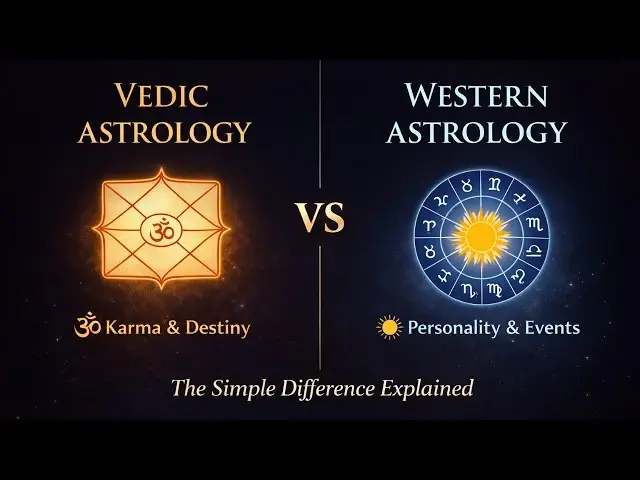
At its core, Western astrology is deeply tied to the Earth’s relationship with the Sun and the changing of the seasons. It is a highly psychological system. In the 20th century, psychologists like Carl Jung heavily influenced Western astrology, shifting its focus from fatalistic predictions (e.g., “you will encounter misfortune on this day”) to character analysis, psychological archetypes, and personal growth.
When you read a Western astrology chart, you are essentially looking at a map of your psyche. It helps you understand your ego, your emotional needs, your communication style, and your internal conflicts. It assumes that you have a high degree of free will and that the stars indicate psychological weather rather than a predetermined destiny.
What is Vedic Astrology (Jyotish)?
Vedic astrology is the traditional astrology of India, originating from the Vedas, the ancient sacred texts of the Hindu tradition. The Sanskrit word for Vedic astrology is Jyotish, which translates to “the science of light.”
Unlike the psychologically oriented Western system, Jyotish is deeply intertwined with the concepts of karma (action and reaction) and dharma (life purpose). Vedic astrology was traditionally used to guide major life decisions: when to marry, what career to pursue, when to start a business, and how to mitigate negative karmic patterns through remedies like gemstones, mantras, and charity.
Vedic astrology is primarily a predictive system. While it certainly describes personality, its true strength lies in forecasting specific life events. It operates on the philosophical belief that the soul incarnates with a specific blueprint of karma to work through in this lifetime, and the birth chart is the mathematical map of that karma.
The Core Difference: Tropical vs. Sidereal Zodiac
The single biggest difference between Western and Vedic astrology—and the reason your zodiac sign likely changes between the two systems—is the type of zodiac they use to calculate planetary positions.
The Tropical Zodiac (Western)
Western astrology uses the Tropical Zodiac. This system is based on the seasons and the Earth’s relationship to the Sun. In the Tropical system, the zodiac begins at 0 degrees Aries precisely on the Vernal Equinox (the first day of Spring in the Northern Hemisphere, usually around March 21st).
Because it is locked to the equinoxes, the Tropical Zodiac is fixed. However, the universe is not fixed.
The Sidereal Zodiac (Vedic)
Vedic astrology uses the Sidereal Zodiac (from the Latin sidus, meaning star). This system measures the positions of the planets against the actual, fixed background of the physical constellations in the sky.
Here is where the math gets fascinating. The Earth wobbles slightly on its axis, a phenomenon known as the Precession of the Equinoxes. Because of this wobble, the position of the Earth relative to the fixed stars shifts backwards by about 1 degree every 72 years.
Around 2,000 years ago, the Tropical and Sidereal zodiacs lined up perfectly. The Vernal Equinox happened right when the Sun entered the actual physical constellation of Aries. But over the last two millennia, that wobble has caused the two systems to drift apart.
Today, there is a difference of about 24 degrees between the two zodiacs. This mathematical difference is called the Ayanamsa. Because 24 degrees is almost an entire zodiac sign (which is 30 degrees long), most planets in your Vedic chart will shift backward by one sign compared to your Western chart. If you are a mid-to-late degree Sagittarius in Western astrology, you are a Scorpio in Vedic astrology.
Sun Signs vs. Moon Signs
Another major operational difference between the two systems is their focal point of identity.
In Western astrology, the Sun is the undisputed king of the chart. When someone asks, “What is your sign?”, they are asking for your Sun sign. The Sun represents your ego, your core identity, your vitality, and the overarching theme of your life’s journey. Western charts revolve around solar energy, making it an excellent tool for understanding your conscious self-expression.
In Vedic astrology, the Sun is important, but the Moon (Chandra) is the supreme luminary. Vedic astrology is a lunar-based system. The Moon represents your mind, your emotional landscape, your intuition, and how you perceive the world. Because the Moon moves very quickly (changing signs every two and a half days), it is considered a much more precise indicator of your daily consciousness and mental well-being than the Sun, which stays in a sign for an entire month.
Furthermore, Vedic astrology places a massive emphasis on the Ascendant or Rising Sign (Lagna). The Lagna dictates the entire structure of the chart, and Vedic astrologers usually read predictions from both the Ascendant and the Moon sign.
Differences in Planetary Systems and Nodes
The tools used to construct the chart differ significantly in terms of which celestial bodies are recognized.
The Outer Planets
When you look at a modern Western birth chart, you will see the traditional visible planets (Sun, Moon, Mercury, Venus, Mars, Jupiter, Saturn) alongside the modern outer planets: Uranus, Neptune, and Pluto. Western astrology assigns great meaning to these outer planets, using them to describe generational shifts, deep psychological trauma, innovation, and collective evolution.
Vedic astrology, relying on ancient, unbroken traditions, generally does not use Uranus, Neptune, or Pluto. It relies strictly on the seven visible luminaries and planets.
Rahu and Ketu (The Lunar Nodes)
While Western astrology includes the North and South Nodes of the Moon, they are often treated as secondary points indicating past-life karma and future-life direction.
In Vedic astrology, the North Node (Rahu) and South Node (Ketu) are treated as full-fledged planets (called Chhaya Grahas, or shadow planets). They are immensely powerful and often feared. Rahu represents obsession, materialism, foreign elements, and insatiable desire. Ketu represents detachment, spirituality, loss, and liberation (Moksha). The placement of Rahu and Ketu in a Vedic chart dictates the deepest karmic extremes of a person’s life.
The Role of Nakshatras (Lunar Mansions)
If you want to understand the extreme precision of Vedic astrology, you have to understand the Nakshatras.
While Western astrology divides the 360-degree sky into 12 zodiac signs of 30 degrees each, Vedic astrology takes it a step further. It overlays the 12 zodiac signs with 27 Lunar Mansions called Nakshatras. Each Nakshatra spans 13 degrees and 20 minutes.
Because the Moon takes about 27 days to orbit the Earth, it spends roughly one day in each Nakshatra. Each of these 27 constellations has its own ruling deity, symbol, animal, and specific energetic frequency.
For example, two people might both have their Moon in Vedic Aries. But one might have their Moon in the Nakshatra of Ashwini (symbolized by a horse’s head, indicating speed, healing, and initiation), while the other has their Moon in Krittika (symbolized by a razor, indicating cutting, purifying fire, and critique). This system provides a microscopic layer of personality and predictive analysis that simply does not exist in standard Western astrology.
Predictive Tools: Transits vs. Dashas
How do these systems predict when an event will happen? This is where the methods diverge sharply.
Western astrology relies heavily on Transits and Progressions. Astrologers look at where the planets are currently moving in the sky (transits) and how they aspect the planets in your birth chart. If Saturn is currently moving over your natal Venus, a Western astrologer might predict a period of restriction or serious commitment in your love life.
Vedic astrology also uses transits (called Gochara), but they are secondary. The primary predictive engine of Jyotish is the Dasha system (specifically the Vimshottari Dasha).
Based on the exact degree of your Moon’s Nakshatra at birth, Vedic astrology calculates a timeline of planetary periods that will unfold over a 120-year lifespan. You might be born into a 7-year Mars Dasha, followed by an 18-year Rahu Dasha, followed by a 16-year Jupiter Dasha.
During a specific planet’s Dasha, that planet becomes the “CEO” of your life. The houses it rules and its placement in your chart will dictate the overarching themes of that period. If you are in a Jupiter Dasha and Jupiter is well-placed in your chart, those 16 years may bring wealth, marriage, and spiritual growth, regardless of what the current daily transits are doing. This Dasha system is why Vedic astrology is renowned for precise event timing.
Which Astrology System Should You Use?
Choosing between Western and Vedic astrology is not about deciding which one is “right” and which is “wrong.” It is about understanding what kind of information you are looking for.
If you are looking for deep psychological insight, character analysis, self-actualization, and a framework to understand your internal emotional landscape and personal agency, Western astrology is incredibly effective. It speaks the language of modern psychology and empowers you to navigate your internal world.
If you are seeking clarity on your life’s purpose, concrete predictions about specific life events (marriage, career changes, financial shifts), understanding of your karmic patterns, and actionable spiritual remedies to mitigate hard times, Vedic astrology is unparalleled. Its mathematical complexity and reliance on the Dasha system offer a grounded, structural view of your life timeline.
Many professional astrologers today actually study both, using the Western Tropical chart for psychological profiling and the Vedic Sidereal chart for timing life events.
Frequently Asked Questions (FAQs)
1. Why did my zodiac sign change in Vedic astrology?
Your sign likely shifted back by one because Western astrology uses the Tropical zodiac (based on the seasons and equinoxes), while Vedic astrology uses the Sidereal zodiac (based on the actual physical constellations in the sky). Due to the Precession of the Equinoxes, there is currently a ~24-degree difference between the two systems.
2. Is Western or Vedic astrology more accurate?
Accuracy depends on what you are trying to achieve. Western astrology is highly accurate for psychological profiling, understanding ego dynamics, and personal growth. Vedic astrology is generally considered more accurate for predictive purposes, timeline forecasting, and identifying specific karmic life events due to its precise Dasha (planetary period) system and use of Nakshatras.
3. Can I be a Leo in Western astrology and a Cancer in Vedic astrology at the same time?
Yes. You do not have to choose one identity over the other. The two systems use different mathematical starting points to map the sky. Your Western Leo Sun describes your psychological drive for self-expression and leadership, while your Vedic Cancer Sun describes your soul’s karmic path and how you process the physical events of your life. Both maps are valid in their respective frameworks.
4. Do I need an exact birth time for Vedic astrology?
An accurate birth time is absolutely critical for both systems, but it is especially vital in Vedic astrology. Because Vedic astrology relies heavily on the Lagna (Ascendant), which changes signs every two hours, and the Moon’s exact degree in a Nakshatra (which dictates your entire life timeline of planetary Dashas), being off by even a few minutes can drastically alter the timing of predicted life events.
The divide between Western and Vedic astrology represents two different lenses for viewing the human experience: the psychological and the karmic. Western astrology provides a brilliant framework for understanding our minds, our choices, and our personal evolution in harmony with the Earth’s seasons. Vedic astrology offers a profound, mathematically rigorous map of our soul’s journey, aligned with the ancient, fixed stars. By understanding the core differences in their zodiacs, planetary focus, and predictive methods, you can utilize the strengths of both systems to gain a holistic, deeply empowered understanding of your life’s path.