When you look at a birth chart, the zodiac signs often get all the attention. However, in the mechanics of astrology, the zodiac signs are just the backdrop. The true driving forces of a birth chart are the planets.
A common analogy used by astrologers is that a birth chart is like a theatrical play. The astrological houses are the stage sets where the action takes place. The zodiac signs are the costumes. But the planets are the actual actors. Each planet represents a specific psychological drive, a fundamental human need, or a specific type of energy.
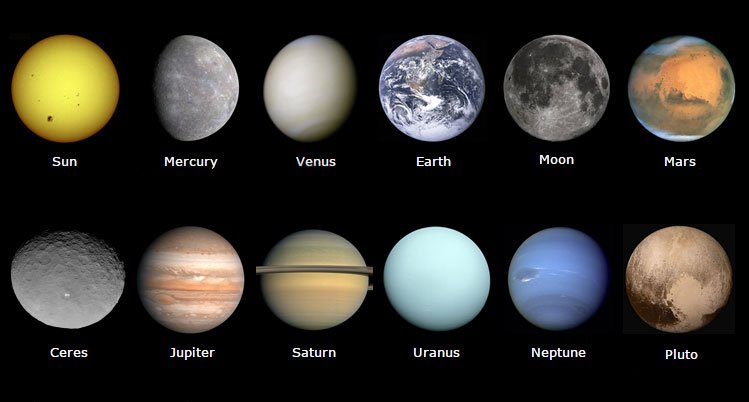
Astronomically, the Sun and Moon are luminaries, and Pluto is a dwarf planet. However, for the sake of simplicity, traditional astrology refers to all of these celestial bodies as “planets.”
In this guide, we will break down the astrological planets into four main categories—the Luminaries, the Inner Planets, the Social Planets, and the Outer Planets—and explain exactly what psychological function each one represents.
The Luminaries: Your Core Identity
The Sun and the Moon are the two most important celestial bodies in your birth chart. Together, they make up the foundation of your personality, representing your conscious ego and your subconscious emotional world.
The Sun (☉)
-
Rules: Leo
-
Keywords: Ego, identity, life purpose, vitality, conscious mind.
-
What it represents: The Sun is the center of our solar system, and in astrology, it is the center of your chart. It represents your fundamental ego and the overarching themes you are trying to master in this lifetime. Your Sun sign dictates what makes you feel alive, confident, and true to yourself. It is the conscious “I am” of your personality.
The Moon (☽)
-
Rules: Cancer
-
Keywords: Emotions, subconscious, instincts, memory, safety.
-
What it represents: The Moon moves rapidly, governing the shifting tides of the ocean and the shifting tides of human emotion. It represents your private, internal world. Your Moon sign dictates how you process feelings, what you require to feel emotionally secure, and how you naturally self-soothe. It is the vulnerable side of your personality that you only reveal to those you deeply trust.
The Inner Planets: Your Personal Drives
The inner planets—Mercury, Venus, and Mars—orbit closely to the Sun. Because they move relatively quickly through the zodiac, their influence is highly personal. They dictate your day-to-day behaviors, including how you think, how you love, and how you fight.
Mercury (☿)
-
Rules: Gemini and Virgo
-
Keywords: Communication, intellect, logic, travel, technology.
-
What it represents: Named after the Roman messenger god, Mercury dictates how your mind works. It governs how you process information, your learning style, and how you speak and write. When you look at someone’s Mercury sign, you understand how to talk to them, how they debate, and how they organize their thoughts.
Venus (♀)
-
Rules: Taurus and Libra
-
Keywords: Love, beauty, values, money, harmony.
-
What it represents: Venus is the planet of aesthetics and attraction. In a birth chart, your Venus sign reveals your “love language.” It dictates what you find beautiful, the type of romantic partner you are drawn to, and how you naturally express affection. It also governs your relationship with material wealth, personal finances, and the things you value most in life.
Mars (♂)
-
Rules: Aries (and traditionally Scorpio)
-
Keywords: Action, passion, aggression, drive, physical energy.
-
What it represents: Mars is the planet of raw, primal energy. It represents your survival instincts, your physical drive, and your sexual chemistry. Crucially, Mars dictates how you assert yourself and how you handle conflict. Looking at a person’s Mars sign will tell you exactly what makes them angry and what fighting style they use to defend themselves.
The Social Planets: How You Relate to the World
The social planets—Jupiter and Saturn—sit between the fast-moving inner planets and the slow-moving outer planets. They govern your relationship with society, ethics, structure, and the broader world around you.
Jupiter (♃)
-
Rules: Sagittarius (and traditionally Pisces)
-
Keywords: Expansion, luck, philosophy, optimism, higher learning.
-
What it represents: Jupiter is the largest planet in our solar system, and astrologically, it acts as a giant magnifying glass. It expands whatever it touches. Jupiter represents where you naturally experience good luck, abundance, and optimism. It also governs higher education, philosophical beliefs, and the search for overarching truth.
Saturn (♄)
-
Rules: Capricorn (and traditionally Aquarius)
-
Keywords: Restriction, discipline, karma, time, hard work.
-
What it represents: If Jupiter is the ultimate optimist, Saturn is the strict realist. Saturn represents the boundaries and limitations of the physical world. Wherever Saturn sits in your birth chart is where you will experience delays, obstacles, and heavy responsibilities. However, Saturn is not a punisher; it is a teacher. The areas governed by Saturn require immense discipline, but they yield the most enduring, mastery-level rewards over time.
The Outer Planets: Generational Shifts
Uranus, Neptune, and Pluto move incredibly slowly. Pluto, for example, can spend up to 30 years in a single zodiac sign. Because of this, everyone born within a certain decade will share the same outer planet signs. Therefore, these planets govern broad generational themes, collective shifts, and deep psychological undercurrents rather than day-to-day personal habits.
Uranus (♅)
-
Rules: Aquarius (Modern)
-
Keywords: Innovation, rebellion, sudden change, eccentricity.
-
What it represents: Uranus is the great disruptor. It governs sudden breakthroughs, technological revolutions, and the urge to rebel against established traditions. In a birth chart, the house where Uranus lands indicates where you are prone to sudden, unexpected changes and where you possess a strong desire to assert your unique, eccentric individuality.
Neptune (♆)
-
Rules: Pisces (Modern)
-
Keywords: Spirituality, dreams, illusion, empathy, boundaries.
-
What it represents: Neptune acts like a dense fog. It dissolves the boundaries between reality and the spiritual realm. It governs artistic inspiration, psychic intuition, and universal empathy. However, because it blurs the lines of reality, Neptune also rules over illusions, escapism, and self-deception. It shows where we are most prone to wearing rose-colored glasses.
Pluto (♇)
-
Rules: Scorpio (Modern)
-
Keywords: Power, destruction, rebirth, taboo, the subconscious.
-
What it represents: Pluto is the planet of the underworld. It governs the cycle of death and rebirth (in a psychological sense). Pluto’s energy is intense, obsessive, and deeply transformative. It strips away what is weak or false so that something stronger can be rebuilt in place. In a chart, Pluto shows where you will experience your most profound power struggles and your greatest capacity for personal reinvention.
Conclusion
Understanding the planets is the key to unlocking the true depth of astrology. You are not just your sun sign; you are a complex, interactive web of planetary energies. You have Mercury’s intellect, Venus’s desire for connection, Mars’s drive to succeed, and Saturn’s capacity for discipline. By learning what each planet represents, you can begin to look at your birth chart not as a static label, but as a dynamic, living map of your psychological potential.
📚 External References
-
NASA Solar System Exploration – Planets: A helpful scientific resource for understanding the physical and astronomical realities of the planets used in astrology. (https://solarsystem.nasa.gov/planets/overview/)
-
The Astrological Association: A credible resource for understanding the historical mythology and established astrological archetypes associated with each planet. (https://www.astrologicalassociation.com/)