If you have ever looked up whether your zodiac sign is compatible with your partner’s, you have likely encountered a hard “yes” or “no” answer. Popular astrology often categorizes pairings into perfect soulmates or absolute disasters based entirely on the sun sign. However, reducing a complex human relationship to a single zodiac sign is a massive oversimplification of a rich, thousands-of-year-old tradition.
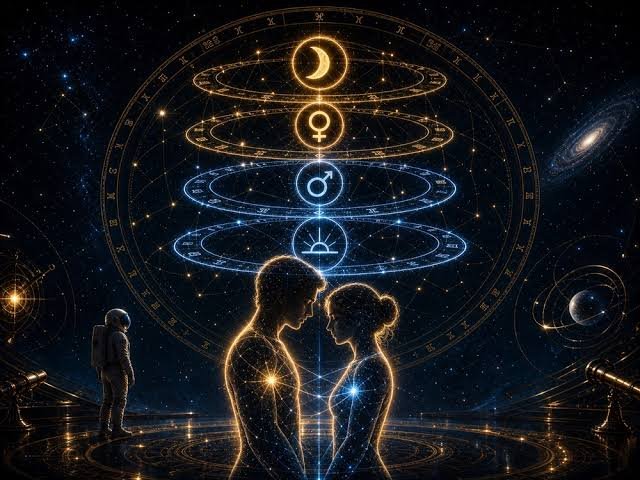
In traditional astrology, analyzing a relationship requires a highly detailed process known as synastry. Synastry is the practice of comparing two complete birth charts to see how their planetary energies interact. It does not exist to tell you if a relationship will succeed or fail; rather, it acts as a diagnostic tool to show where you will naturally flow together and where you will have to work hard to understand one another.
To read a zodiac compatibility chart accurately, you must look far beyond the sun. You must examine the emotional landscape of the Moon, the romantic languages of Venus, the conflict styles of Mars, and the mathematical angles that connect them all.
What Is a Compatibility Chart (Synastry)?
A standard birth chart (natal chart) is a snapshot of the sky at the exact minute and location of your birth. It contains all 12 zodiac signs, the 12 astrological houses, and the specific placements of the sun, moon, and planets.
A compatibility chart, or synastry chart, takes your birth chart and overlays your partner’s birth chart directly on top of it. By putting the two charts together, an astrologer can measure the exact distance between your planets and your partner’s planets. This reveals the specific dynamics of the relationship. For example, your partner’s communication planet (Mercury) might sit exactly on top of your emotional planet (the Moon), indicating that they know exactly how to talk to you to make you feel safe.
The “Big Three” in Relationship Astrology
When looking at a synastry chart, the best place to start is by comparing the “Big Three” of both partners: the Sun, the Moon, and the Rising sign (Ascendant).
The Sun: Core Identity and Ego
Your sun sign represents your core identity, your ego, and the overarching theme of your life’s journey. When comparing sun signs, you are looking at whether two people are traveling in the same general direction. Compatible sun signs (such as two Fire signs, or a Fire and Air sign) usually indicate a mutual respect for each other’s core motivations. However, a clashing sun sign combination is rarely a dealbreaker if the rest of the chart is harmonious.
The Moon: Emotional Needs and Safety
In relationship astrology, the Moon is arguably more important than the Sun. The Moon governs your private self, your emotional processing, and what you require to feel safe and nurtured. If two people have compatible moon signs, they can easily soothe one another during times of stress. They feel “at home” together.
-
Example: If Partner A has a Water moon (needs emotional depth and reassurance) and Partner B has an Earth moon (offers practical stability and physical presence), they will naturally comfort one another.
The Rising Sign (Ascendant): First Impressions
The Rising sign is the mask you wear when you meet someone new, as well as your immediate physical environment. In synastry, strong connections to the Rising sign indicate intense initial physical attraction. It governs the “spark” you feel when you first lock eyes across a room.
Venus and Mars: The Planets of Love and Conflict
Once you understand the basic identities and emotional needs of the couple, you must look at how they express romance and handle anger. This is governed by Venus and Mars.
Venus: How We Love and What We Value
Venus dictates your love language. It represents what you find beautiful, how you spend money, and how you want to be romanced. If a couple has compatible Venus signs, they will likely enjoy the same types of dates, agree on financial priorities, and naturally show affection in a way the other person understands.
-
Example: If both partners have Venus in Air signs (Gemini, Libra, Aquarius), they will show love through intellectual conversation, sharing books, and giving each other social freedom.
Mars: Desire, Drive, and How We Fight
Mars is the planet of action, primal desire, and aggression. In a compatibility chart, Mars dictates sexual chemistry and conflict resolution. When two people’s Mars signs clash, their arguments can be highly destructive. When they harmonize, they can conquer goals together and maintain a vibrant physical connection.
-
Example: If Partner A has Mars in Aries (fights loudly, wants immediate resolution) and Partner B has Mars in Scorpio (fights quietly, holds long grudges), they will have to work incredibly hard to find a fair fighting style.
Aspects: The Geometry of the Relationship
The most technical part of reading a compatibility chart is looking at the “aspects.” Aspects are the specific geometric angles formed between one person’s planets and the other’s. They are the actual mechanics of the relationship.
Harmonious Aspects (Trines and Sextiles)
When planets are 120 degrees apart (a trine) or 60 degrees apart (a sextile), the energy flows easily. These are the areas of the relationship that feel effortless.
-
What it means: If your Venus is trine your partner’s Sun, there is a natural, effortless flow of affection and mutual admiration. You do not have to try hard to make the other person feel loved.
Challenging Aspects (Squares and Oppositions)
When planets are 90 degrees apart (a square) or 180 degrees apart (an opposition), the energy clashes. These aspects represent friction.
-
What it means: If your Mercury is square your partner’s Moon, your natural way of speaking may frequently hurt their feelings, requiring constant translation and patience.
While challenging aspects sound negative, they are actually vital for a long-term relationship. A chart with only harmonious aspects is often boring and lacks the “glue” that keeps a couple engaged. Challenging aspects provide the necessary friction that forces both partners to grow, evolve, and remain fascinated by one another.
Houses: Where the Relationship Plays Out
The final layer of a synastry chart involves looking at the astrological houses. Your birth chart is divided into 12 houses, each representing a different area of life (career, home, friendship, etc.).
When you overlay your partner’s chart onto yours, their planets will land in specific houses in your chart. This tells you where their energy will impact your life the most.
-
The 7th House (Partnership): If your partner’s Sun or Venus lands in your 7th house, you will naturally view them as ideal marriage material.
-
The 4th House (Home and Family): If their planets fall in your 4th house, they will make you feel a deep sense of family and domestic security.
-
The 10th House (Career): If their planets fall in your 10th house, they will likely act as a mentor, pushing you to achieve your professional goals.
Moving Beyond Basic Horoscopes
Astrology is an incredible vocabulary for understanding human behavior, but it is not a tool for determining fate. There is no such thing as a perfectly compatible astrological chart, just as there is no such thing as an entirely incompatible one.
When you learn to read a full compatibility chart, you stop looking for permission from the stars to love someone. Instead, you gain a highly practical map of your partner’s psychological landscape. You learn that when they are quiet, they are not ignoring you—they just have a Water moon that needs internal processing time. You learn that their blunt communication is not an attack, but rather the natural expression of a Fire-ruled Mercury.
By analyzing the elements, the inner planets, and the geometric aspects, you can move away from oversimplified horoscopes and use astrology for its truest purpose: fostering profound empathy, patience, and understanding in your most important relationships.
📚 External References
-
The Astrological Association: A highly credible resource for understanding the historical transition of Hellenistic relationship analysis (synastry) into modern practice. (https://www.astrologicalassociation.com/)
-
Encyclopedia Britannica – Astrology: For historical verification of how planetary aspects, houses, and the zodiac wheel have traditionally been structured in Western astrology. (https://www.britannica.com/topic/astrology)