A birth chart, also known as a natal chart, is a mathematical snapshot of the sky at the exact minute and location you were born. For thousands of years, astrologers have used this specific arrangement of the sun, moon, and planets as a symbolic map of human personality, potential, and life cycles.
Looking at a birth chart for the first time can be incredibly overwhelming. It looks like a complex geometric wheel covered in strange glyphs, numbers, and intersecting lines. However, you do not need to be a professional astrologer to understand the basics. The chart is built on a highly logical structure composed of four main layers: the planets, the zodiac signs, the astrological houses, and the geometric angles (aspects) between them.
This guide will break down that structure step-by-step. By learning the fundamental vocabulary of astrology, you can begin to decode your chart and understand the unique psychological blueprint it represents.
What You Need to Calculate Your Chart
Before you can read a chart, you need to generate one. You cannot rely solely on your birth date. To cast an accurate natal chart using free online software, you must have three pieces of information:
-
Your exact date of birth.
-
Your exact time of birth. (This must be precise down to the minute, ideally pulled from a long-form birth certificate. Even a ten-minute guess can drastically alter the chart’s meaning).
-
Your city of birth. (This determines the correct global coordinates and time zone).
Why does the time matter so much? The Earth rotates constantly. Because of this rotation, the zodiac sign rising on the eastern horizon changes completely every two hours. Without an exact time, you cannot calculate your Rising sign, and you cannot place the planets into their correct astrological houses.
Once you have your chart generated, use the following steps to start translating the symbols.
Step 1: Understand the “Big Three”
The easiest way to begin reading a birth chart is to isolate the three most important placements, commonly called the “Big Three.” These dictate your core identity, your emotional needs, and your social mask.
The Sun Sign: Your Core Ego
The Sun represents your conscious mind, your ego, and your primary life force. It dictates the overarching themes and goals of your life. When you read your Sun sign, you are reading about the fundamental traits you are striving to develop and the energy that makes you feel most alive.
The Moon Sign: Your Inner World
The Moon represents your subconscious, your emotional processing, and your instincts. It moves very quickly, changing signs every two and a half days. Your Moon sign reveals what you need in order to feel emotionally safe, how you self-soothe, and the vulnerable side of your personality that you only show to people you deeply trust.
The Rising Sign (Ascendant): Your Outer Mask
The Rising sign is the specific zodiac sign that was crossing the eastern horizon the minute you were born. It represents your physical body, your outward appearance, and the immediate first impression you make on strangers. It acts as the “front door” to your chart. Additionally, the planet that rules your Rising sign is considered the “chart ruler,” making it one of the most influential planets in your entire reading.
Step 2: Learn the Planets (The “What”)
If a birth chart is a theatrical play, the planets are the actors on the stage. Each planet represents a specific psychological drive or human function. Wherever a planet lands in your chart is where that specific energy is operating.
The Inner Planets (Personal Drives) These planets move quickly through the zodiac and dictate your day-to-day personality.
-
Mercury: How you communicate, learn, and process logic.
-
Venus: How you show affection, what you find beautiful, and what you value financially.
-
Mars: How you assert yourself, your physical energy, your sex drive, and how you express anger.
The Social Planets (Interpersonal Drives) These planets govern how you relate to society and structure.
-
Jupiter: Where you experience luck, expansion, optimism, and philosophical growth.
-
Saturn: Where you experience restriction, discipline, hard work, and life lessons.
The Outer Planets (Generational Drives) These planets move incredibly slowly, staying in one sign for years or decades. They represent massive generational shifts and deep psychological transformations.
-
Uranus: Innovation, rebellion, and sudden disruption.
-
Neptune: Spirituality, dreams, illusion, and boundaries.
-
Pluto: Power, destruction, rebirth, and profound transformation.
Step 3: Decode the Zodiac Signs (The “How”)
If the planets are the actors, the 12 zodiac signs are the costumes they wear. The zodiac sign modifies how a planet expresses its energy.
For example, Mars is the planet of action and anger.
-
If your Mars is wearing the costume of Aries (a fiery, impulsive sign), your anger is expressed loudly, immediately, and assertively.
-
If your Mars is wearing the costume of Taurus (an earthy, patient sign), your anger is slow to build, highly stubborn, and expressed through passive resistance.
To understand how a planet operates, you must understand the elemental nature of the sign it occupies.
-
Fire signs (Aries, Leo, Sagittarius): Express energy passionately, quickly, and intuitively.
-
Earth signs (Taurus, Virgo, Capricorn): Express energy practically, slowly, and materially.
-
Air signs (Gemini, Libra, Aquarius): Express energy intellectually, socially, and abstractly.
-
Water signs (Cancer, Scorpio, Pisces): Express energy emotionally, intuitively, and deeply.
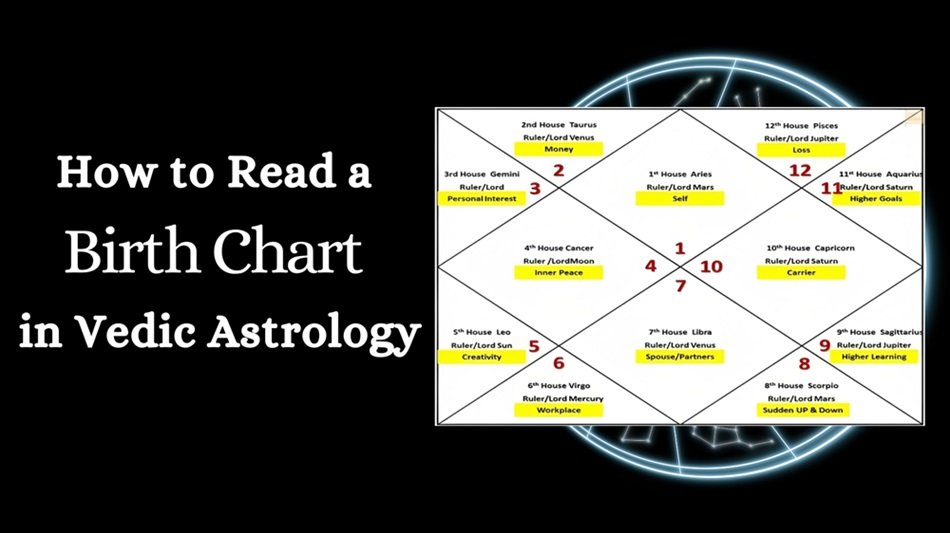
Step 4: Explore the Astrological Houses (The “Where”)
If the planets are the actors and the signs are the costumes, the 12 astrological houses are the stage sets where the action takes place. The inner wheel of your birth chart is divided into 12 pie slices. Each slice represents a different area of human life.
The house a planet lands in tells you where that planetary energy will be most visible in your life.
-
1st House: Self-image, physical body, and first impressions (ruled by the Ascendant).
-
2nd House: Personal finances, material possessions, and self-worth.
-
3rd House: Communication, siblings, local travel, and early education.
-
4th House: Home, family roots, ancestry, and private domestic life.
-
5th House: Creativity, romance, children, and pleasure.
-
6th House: Daily routines, physical health, and acts of service.
-
7th House: One-on-one partnerships, marriage, and open enemies.
-
8th House: Shared resources, intimacy, trauma, and transformation.
-
9th House: Higher education, long-distance travel, philosophy, and religion.
-
10th House: Career, public reputation, and authority figures (marked by the Midheaven).
-
11th House: Friendships, social networks, and long-term hopes.
-
12th House: The subconscious, hidden enemies, isolation, and spiritual closure.
Example: If you have Venus (the planet of love) in the 10th House (career), you might meet your romantic partners at work, or you might place a high aesthetic value on your professional reputation.
Step 5: Look at Planetary Aspects (The “Connections”)
The final layer of reading a birth chart involves looking at the lines crisscrossing the center of the wheel. These are the aspects—specific geometric angles that planets form with one another. Aspects represent the dialogue between the different parts of your personality.
-
Conjunction (0 degrees): Two planets sit right next to each other. Their energies blend together powerfully, for better or worse.
-
Trine (120 degrees) & Sextile (60 degrees): These are harmonious angles. The planets support each other, creating natural talents, easy flow, and effortless strengths.
-
Square (90 degrees) & Opposition (180 degrees): These are challenging angles. The planets are fighting for control or pulling in opposite directions. While they cause internal friction and stress, these aspects are vital because they force you to grow, overcome obstacles, and evolve.
Putting It All Together: Your First Reading
Reading a birth chart is a process of synthesis. You are combining the Planet + the Sign + the House + the Aspects to create a complete sentence.
When you first look at your chart, do not try to memorize everything at once. Start simple. Find your Sun, look at what sign it is in, and note which house it occupies. Then, do the same for your Moon and your Rising sign. Next, locate Mercury, Venus, and Mars to understand how you think, love, and act.
Astrology is a highly symbolic language. A birth chart does not dictate a predetermined fate; it simply highlights your natural inclinations, your inherent challenges, and your greatest potentials. By breaking the chart down into these foundational steps, you can begin to translate the stars and gain a profoundly useful tool for self-reflection and personal growth.
📚 External References
-
Astro.com (Astrodienst): Widely considered the most accurate and reliable free tool for calculating exact natal charts, utilizing Swiss Ephemeris data. (https://www.astro.com/)
-
Encyclopedia Britannica – Astrology: For historical verification of how the 12 houses, zodiac signs, and planetary bodies were traditionally structured in Hellenistic and Western astrology. (https://www.britannica.com/topic/astrology)