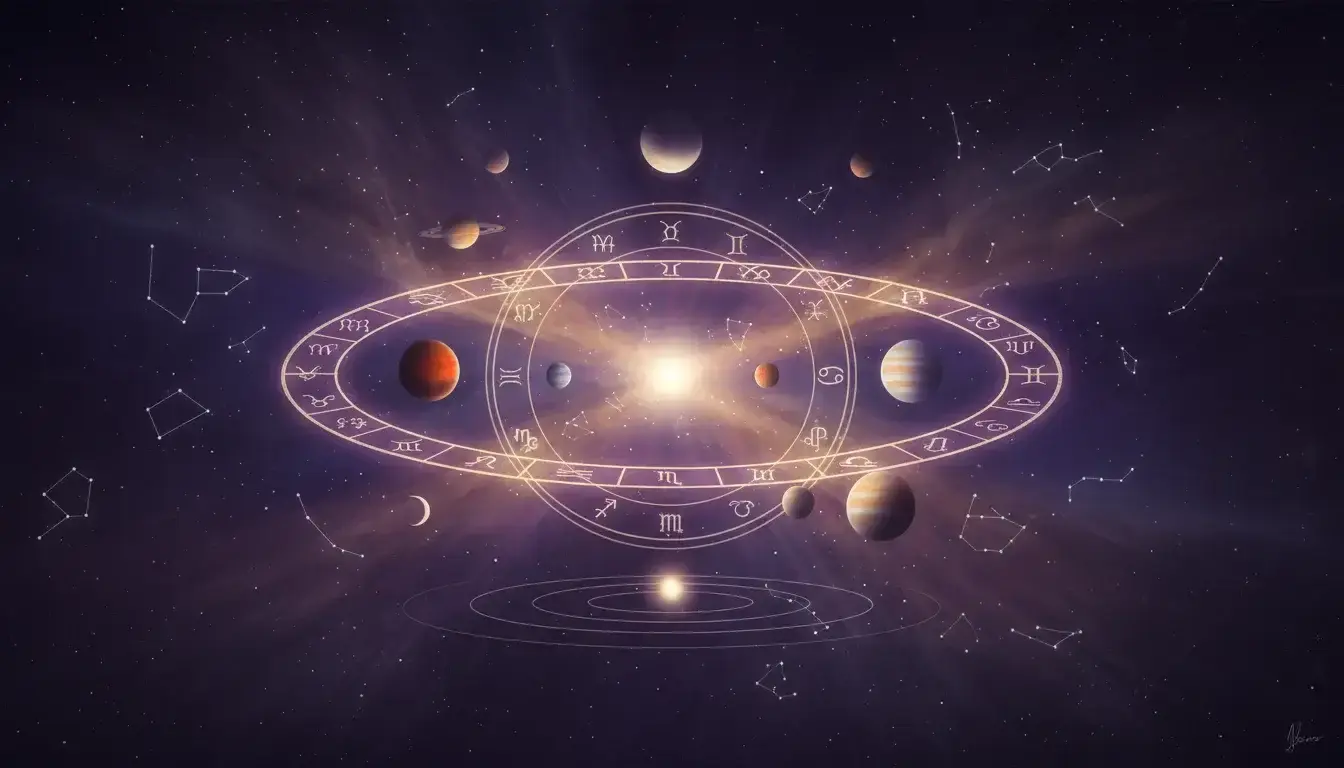
Have you ever stepped outside on a clear, dark night, looked up at a canopy of glittering stars, and felt a profound sense of wonder? For thousands of years, humanity has been captivated by the night sky. Long before city lights obscured our view of the Milky Way, our ancestors relied on the heavens to tell time, navigate vast oceans, and know when to plant their crops.
In those ancient times, observing the physical movements of the stars and interpreting their spiritual or earthly meaning were the exact same practice. But today, if you look to the stars, you are likely engaging with one of two distinct fields: astronomy or astrology.
While they share the same roots and even look at the same celestial bodies, modern astrology and astronomy could not be more different. One relies on telescopes, mathematics, and the scientific method; the other relies on birth charts, archetypes, and the search for personal meaning.
If you have ever confused the two, or wondered how a single ancient practice split into a hard science and a popular belief system, you are in the right place. Let’s dive into the fascinating history of astrology and astronomy, explore their shared origins, and break down their very different approaches to the universe.
The Shared Origins: When Science and Mysticism Were One
To understand the difference between astrology and astronomy, we have to travel back in time. For most of human history, the two disciplines were completely inseparable. The word “astronomy” comes from the Greek words astron (star) and nomos (law), meaning the law of the stars. “Astrology” comes from astron and logia (study of), meaning the study of the stars.
In ancient Babylon, Egypt, and Greece, the people who charted the sky were both scientists and spiritual advisors. The logic was simple: if the movement of the Sun dictates the seasons, and the phases of the Moon dictate the ocean tides, then surely the movements of the planets must dictate the fates of kings, the outcomes of wars, and the destiny of empires.
Historically, the most famous astronomers were also practicing astrologers.
-
Ptolemy: This 2nd-century Greek polymath wrote the Almagest, a foundational text for astronomy, but he also wrote the Tetrabiblos, which remains one of the core texts of Western astrology today.
-
Johannes Kepler: Famous for discovering the laws of planetary motion in the 17th century—a massive leap forward for physics and astronomy—Kepler also cast horoscopes for royalty to fund his scientific research.
-
Galileo Galilei: The “father of observational astronomy” who championed the idea that the Earth revolves around the Sun, Galileo also practiced medical astrology, teaching medical students how to use the stars to treat illnesses.
For centuries, you could not be an astronomer without being an astrologer. Tracking the physical location of a planet was simply the first step to interpreting what that planet’s movement meant for humanity.
The Great Divide: When the Paths Diverged
So, what caused the greatest divorce in cosmic history? The answer lies in the Scientific Revolution and the Age of Enlightenment (roughly the 16th to 18th centuries).
The invention of the telescope changed everything. Suddenly, the sky was no longer a mysterious, untouchable realm of the gods. Humans could look through a lens and see the craters on the Moon, the rings of Saturn, and the moons orbiting Jupiter.
During this era, thinkers like Nicolaus Copernicus and Isaac Newton began explaining the universe through mathematics, gravity, and physics. When it was definitively proven that the Earth was not the center of the universe—but rather just one of many planets orbiting the Sun—the astrological model, which placed Earth at the center of a symbolic cosmic wheel, began to lose its scientific credibility.
Astronomy embraced the scientific method: formulating hypotheses, gathering empirical data, and rigorously testing theories. Astrology, which could not be proven or tested in a laboratory, was gradually pushed out of universities and scientific academies. The two disciplines went their separate ways, never to officially reunite.
What is Astronomy Today? The Science of the Cosmos
Today, astronomy is a recognized, rigorous natural science. It is the study of celestial objects (such as stars, planets, comets, and galaxies) and the physical universe as a whole.
Astronomers do not ask what the universe means for your love life; they ask how the universe physically works. Their approach is entirely grounded in empirical data, mathematics, and physics.
The Methodology of Astronomy
Modern astronomy relies on incredibly advanced technology. Instead of just looking at visible light, astronomers use massive telescopes to observe the universe through radio waves, infrared light, X-rays, and gamma rays. Instruments like the Hubble Space Telescope and the James Webb Space Telescope have allowed us to peer billions of light-years away, looking back in time to the very origins of the universe.
The Goals of Astronomy
The primary goals of astronomy include:
-
Understanding the origins and evolution of the universe (the Big Bang theory).
-
Discovering exoplanets (planets orbiting other stars) that might harbor life.
-
Studying the life cycles of stars, from stellar nurseries to spectacular supernova explosions and black holes.
-
Mapping dark matter and dark energy, the mysterious forces that make up the vast majority of our universe.
Astronomy is objective. If an astronomer in Japan and an astronomer in Brazil look at the same star through the same equipment, they will record the exact same chemical composition and distance.
What is Astrology Today? The Language of Meaning
While astronomy became the science of the physical universe, astrology evolved into a symbolic language and a tool for psychological self-reflection. Astrology posits that there is a meaningful correlation between the alignment of celestial bodies at the exact moment of a person’s birth and their personality, behavior, and life cycles.
Astrology is not a science, and modern practitioners generally do not claim it to be one. Instead, it is a belief system, an art form, and a framework for understanding the human experience.
The Methodology of Astrology
Astrology operates on the ancient hermetic principle of “As above, so below.” The core tool of an astrologer is the birth chart (or natal chart)—a snapshot of the sky taken from the exact time, date, and location of a person’s birth.
Astrologers interpret the placement of the Sun, Moon, and planets within the twelve zodiac signs and twelve “houses” of the chart. They use ancient archetypes to derive meaning. For example, Mars represents action and drive, Venus represents love and values, and Saturn represents discipline and boundaries.
The Goals of Astrology
The primary goals of modern astrology include:
-
Self-Discovery: Helping individuals understand their strengths, weaknesses, and subconscious drives.
-
Timing and Cycles: Using planetary transits to understand current life themes, such as career shifts or relationship challenges.
-
Validation: Providing a vocabulary for people to articulate complex emotional states.
Astrology is highly subjective. Its power does not lie in measuring gravitational pulls, but in providing a mirror for human psychology and personal growth.
Key Differences: A Side-by-Side Comparison
If you are still trying to wrap your head around the differences, here is a clear breakdown of how astronomy and astrology diverge in their approaches:
-
Focus: Astronomy focuses on the physical properties of celestial bodies (mass, distance, temperature). Astrology focuses on the symbolic meaning of celestial bodies in relation to human life.
-
Method: Astronomy uses the scientific method, math, and advanced technology. Astrology uses ancient symbolic systems, intuition, and psychological interpretation.
-
The Zodiac vs. The Constellations: Astronomers recognize 88 uniquely sized, scientifically defined constellations in the sky. Astrologers use the Zodiac—a mathematical division of the ecliptic (the Sun’s apparent path) into 12 equal 30-degree slices, which no longer perfectly align with the physical constellations due to the Earth’s “wobble” over thousands of years.
-
Objective vs. Subjective: Astronomy seeks objective, universal truths that can be proven. Astrology offers subjective, personal insights that are felt and experienced.
Can Astrology and Astronomy Coexist?
There is often friction between the two fields. Many astronomers view astrology with frustration, labeling it a pseudoscience that misleads the public about how the universe works. On the other hand, many modern astrologers feel that hardcore science dismisses the very real, innate human need for spiritual connection, mystery, and personal meaning.
But do they have to be enemies? Not necessarily.
Think of astronomy as the architecture of a house. It tells you exactly how the foundation was poured, what materials make up the walls, and how the plumbing works. It is factual, essential, and structurally sound.
Think of astrology as the interior design of that same house. It is the art of making the space feel like a home. It deals with color, mood, personality, and how the space makes you feel.
You wouldn’t ask an interior designer to calculate the load-bearing capacity of a support beam, just as you wouldn’t ask a structural engineer to choose the emotional color palette of your living room. Both have different purposes. Science tells us how the universe was built. Astrology attempts to help us figure out how to live in it with intention and meaning.
Frequently Asked Questions (FAQs)
1. Is astrology considered a science? No. While astrology uses astronomical data to chart the positions of the planets, its interpretations and predictions cannot be empirically proven using the scientific method. It is classified by the scientific community as a pseudoscience, and is best understood as a symbolic language or belief system.
2. Why are astrological zodiac signs different from actual constellations? Western astrology is based on the “Tropical Zodiac,” which is tied to the Earth’s seasons (starting with the Vernal Equinox), not the actual background stars. Because the Earth slightly wobbles on its axis (a phenomenon called the precession of the equinoxes), the physical constellations have shifted over the last 2,000 years. Astronomers look at the actual stars; Western astrologers look at a fixed, season-based mathematical map.
3. Did the invention of telescopes destroy astrology? It did not destroy it, but it did cause the split between the two fields. Telescopes allowed humans to prove that the Earth orbits the Sun, dismantling the Earth-centric model that ancient astrology was built upon. This forced astrology out of the realm of hard science and into the realm of mysticism and psychology.
4. What is Ophiuchus, and does it change my zodiac sign? Ophiuchus is a physical constellation that the Sun passes through, recognized by astronomers. However, it is not one of the 12 signs of the Western astrological Zodiac. Because Western astrology divides the sky into 12 equal seasonal slices regardless of the actual star clusters, Ophiuchus does not change your astrological sign.
Final Thoughts
The story of astrology and astronomy is the story of human curiosity. From the ancient Babylonians tracking the moon to the scientists operating the James Webb Space Telescope today, our desire to look up and understand our place in the cosmos has never faded.
Astronomy expands our minds, showing us the staggering, beautiful, and sometimes terrifying physical reality of a vast universe. Astrology expands our inner awareness, giving us a comforting, ancient framework to understand our own personalities and the cycles of our lives.
While their approaches are fundamentally different—one rooted in cold, hard facts, and the other rooted in rich, poetic symbolism—they both stem from the exact same human impulse: the profound need to connect with the stars. Whether you find your answers in a physics textbook or a natal chart, looking up is always the first step.