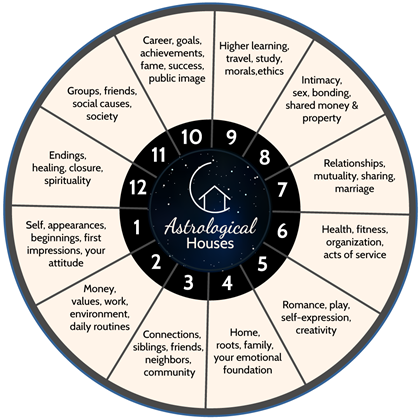
If you want to understand how a birth chart truly works, you have to move beyond the planets and the zodiac signs and look at the actual structure of the chart itself. In astrology, the inner wheel of a natal chart is divided into 12 distinct sections. These sections are called the astrological houses.
If the planets represent what is happening (your psychological drives) and the zodiac signs represent how it is happening (the style or flavor of the energy), the houses represent where it is happening.
Each house rules a specific area of human life, ranging from your personal finances and career to your marriage and subconscious mind. The specific house that a planet occupies tells an astrologer exactly where that planetary energy will show up in your daily reality.
In this guide, we will break down the structure of the astrological wheel, explain the traditional meanings of all 12 houses, and provide practical examples of how to interpret them in a real birth chart.
The Structure of the Astrological Wheel
Before looking at the individual houses, it helps to understand how the wheel is built. The 12 houses are not random pie slices; they are based on the Earth’s 24-hour rotation. The chart is anchored by two intersecting lines that create four quadrants.
-
The Horizon Line (Ascendant/Descendant): The horizontal line separates the top half of the chart (the sky above you when you were born) from the bottom half (the sky below the Earth). The left side is the Ascendant (1st House cusp), representing the self. The right side is the Descendant (7th House cusp), representing others.
-
The Vertical Line (Midheaven/Imum Coeli): The vertical line represents the highest point the sun reaches in the sky (the Midheaven or 10th House cusp, representing public life and career) and the lowest point beneath the Earth (the Imum Coeli or 4th House cusp, representing private roots and family).
The houses follow a logical human journey. The first six houses sit below the horizon line and deal with personal, internal, and foundational matters. The last six houses sit above the horizon line and deal with interpersonal, social, and public matters.
The 12 Astrological Houses Explained
Below is a breakdown of the 12 houses, their core themes, and a practical example of how a planetary placement might play out in each area.
The 1st House: The House of Self
The 1st House is the most personal sector of the chart. It begins with the Ascendant (Rising sign) and rules your physical body, your outward appearance, your basic temperament, and the immediate first impression you make on others. It is the lens through which you view the world.
-
Practical Example: If you have Mars (the planet of action and aggression) in the 1st House, you likely come across as highly assertive, energetic, and perhaps a bit physically intimidating. You take bold, immediate action when starting new chapters in your life.
The 2nd House: The House of Value
The 2nd House governs the material world. It rules your personal finances, your physical possessions, your earning capacity, and the things you value most. On a psychological level, it also rules your self-worth and how you build a sense of foundational security.
-
Practical Example: If you have Venus (the planet of beauty and money) in the 2nd House, you may have a talent for attracting wealth, but you might also spend a lot of money on luxury items, art, or comfortable surroundings to feel secure.
The 3rd House: The House of Communication
The 3rd House governs your immediate environment and how you process information. It rules your communication style, early childhood education, siblings, extended family, neighbors, and short-distance travel (like your daily commute).
-
Practical Example: If you have Mercury (the planet of intellect and speech) in the 3rd House, your mind is constantly active. You are likely an excellent writer, speaker, or teacher who naturally excels at gathering data and sharing information with your local community.
The 4th House: The House of Home and Family
Sitting at the very bottom of the chart, the 4th House is the foundation of your life. It rules your physical home, your parents, your ancestry, your childhood conditioning, and your deepest emotional roots. It is the private self you retreat to behind closed doors.
-
Practical Example: If you have the Moon (the planet of emotion and nurturing) in the 4th House, your emotional well-being is deeply tied to your home environment. You likely possess a strong maternal instinct, a deep connection to your family history, and a need for a peaceful, safe domestic life.
The 5th House: The House of Pleasure
The 5th House is where you go to play. It rules creativity, self-expression, romance, casual dating, hobbies, sports, and children. It is the sector of the chart dedicated to joy, drama, and the things you do purely for fun rather than obligation.
-
Practical Example: If you have the Sun (the planet of ego and identity) in the 5th House, you are naturally theatrical and creative. You want to be recognized for your artistic talents, and you likely shine brightest when you are entertaining others or engaging with children.
The 6th House: The House of Health and Routine
The 6th House brings you back to practical reality. It governs your daily routines, your physical health, diet, hygiene, and the mundane chores of life. It also rules your day job, your work environment, acts of service, and small pets.
-
Practical Example: If you have Saturn (the planet of discipline and restriction) in the 6th House, you may take your daily routines incredibly seriously. You are highly responsible at work, but you must be careful not to overwork yourself to the point of physical exhaustion or health issues.
The 7th House: The House of Partnership
Crossing the horizon line, the 7th House shifts the focus from “me” to “we.” It rules all committed, one-on-one partnerships. This includes marriages, long-term romantic relationships, business partnerships, and binding legal contracts. It is also the house of “open enemies” or rivals.
-
Practical Example: If you have Jupiter (the planet of luck and expansion) in the 7th House, you likely experience immense personal growth and good fortune through your marriage or business partnerships. You are drawn to partners who are philosophical, generous, or from different cultural backgrounds.
The 8th House: The House of Transformation
The 8th House is arguably the most intense sector of the chart. It rules shared resources (other people’s money, inheritances, taxes, and joint bank accounts). Psychologically, it governs intimacy, trauma, taboos, the occult, and the cycle of death and rebirth.
-
Practical Example: If you have Pluto (the planet of power and destruction) in the 8th House, your life may involve profound psychological transformations. You have an incredible ability to survive crises, investigate hidden truths, and reinvent yourself after experiencing profound emotional depths.
The 9th House: The House of Philosophy
The 9th House represents the expansion of the mind. It governs higher education (universities), long-distance and international travel, philosophy, religion, publishing, and foreign languages. It is where you seek the overarching meaning of life.
-
Practical Example: If you have Uranus (the planet of rebellion and sudden change) in the 9th House, your belief systems are likely highly unconventional. You might frequently change your university major, experience sudden spiritual awakenings, or find profound inspiration by traveling to highly unusual foreign destinations.
The 10th House: The House of Career and Public Image
Sitting at the very top of the chart, the 10th House is your most public self. It rules your career path, your public reputation, your legacy, fame, and authority figures. It represents what you are striving to achieve in the eyes of society.
-
Practical Example: If you have Mars (the planet of drive and ambition) in the 10th House, you are fiercely competitive in your professional life. You are naturally suited for leadership roles, entrepreneurship, and careers that require independent, decisive action.
The 11th House: The House of Friendships
The 11th House governs your social networks and community. It rules friendships, clubs, organizations, and collective groups. It is also known as the house of “hopes and dreams,” representing the long-term goals you wish to achieve with the help of your community.
-
Practical Example: If you have Venus (the planet of harmony and socializing) in the 11th House, you are likely incredibly popular. You have a talent for bringing people together, and you may find financial or romantic success through your extended network of friends and professional associations.
The 12th House: The House of the Subconscious
The final house is the most hidden part of the chart. The 12th House rules the subconscious mind, dreams, secrets, karma, and spiritual closure. It is associated with places of isolation (hospitals, prisons, monasteries) and the things you hide from the rest of the world—including your own hidden self-sabotaging behaviors.
-
Practical Example: If you have the Moon (emotions) in the 12th House, you are deeply empathetic, perhaps to a psychic degree, but you prefer to process your emotions in total solitude. You may struggle to express your feelings openly, requiring ample quiet time to recharge away from the heavy energies of the outside world.
A Common Misconception: The “Empty” House
When beginners first cast their birth chart, they often panic if they see an “empty” house. Because there are 12 houses and only 10 major planetary bodies (the Sun, Moon, and eight planets), it is mathematically impossible to have a planet in every house. You will have several empty houses.
An empty house does not mean that area of your life is empty or doomed. For example, an empty 7th House does not mean you will never get married.
If a house is empty, astrologers simply look at the zodiac sign that sits on the edge (the cusp) of that house. The planet that rules that specific zodiac sign dictates how that area of your life will unfold. The area simply operates more smoothly in the background, without the intense, hyper-focused energy of a planet sitting directly inside it.
Conclusion
Understanding the 12 astrological houses is what grounds astrology in everyday reality. While your sun sign might tell you that you are naturally creative or deeply ambitious, the houses reveal where that creativity will be expressed or where that ambition will be focused. By mapping the planets to these 12 distinct stages of life, the birth chart becomes a highly practical, surprisingly specific tool for navigating your personal path.
📚 External References
-
Astro.com (Astrodienst): A highly reliable resource for understanding house systems (such as Placidus or Whole Sign) and calculating a chart accurately. (https://www.astro.com/astrology/in_intro_houses_e.htm)
-
Encyclopedia Britannica – Astrology: For historical verification of how the 12 houses have traditionally been mapped to earthly affairs and daily life in Western astrology. (https://www.britannica.com/topic/astrology)